We focus on maximizing the economic and environmental benefits gained from properly managing organic waste via our composting process, and in our rigorous testing platform. A judicious infusion of clean food waste into our approach results in a rich, and biodiverse compost. While the prevention of potent methane emissions and costly pollution from landfills is a clear environmental benefit of diverting organic matter, we recognize the compost product as an organic input with consistent quality to replace conventional synthetic fertilizers and crop protection programs.
our approach for better compost:
We have found that a carefully managed food waste stream, sourced from diverse global supply chains, acts as an exceptional inoculant for local compostable materials. This turns a complex logistics and awareness challenge into a substantial market opportunity. This production of alternative inputs relies on the ecological vigor and biodiversity necessary to establish resilient plants growing in soils treated with our soil health compost solutions.
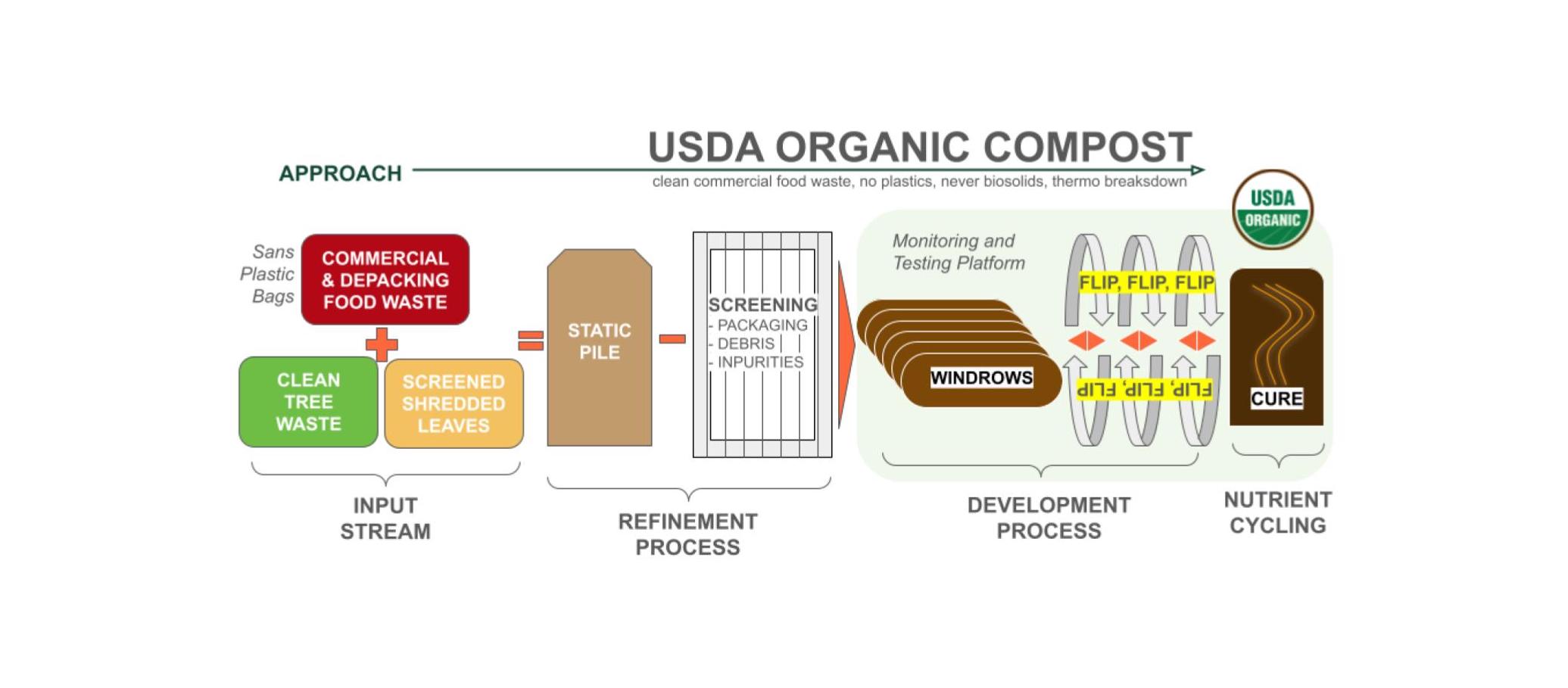

our pioneering testing platform:
We conduct thorough testing across independent labs on our compost to ensure it is both ecologically balanced and biologically sound. Our thermophilic composting process consistently reaches temperatures above 144°F, which effectively eliminates pathogens and weed seeds.
This process yields our Brick Ends Farm black-gold compost products, which result from processing organic waste with minimal off-gassing, a cleaner waste stream, and none of the odors that concern local residents. Similarly, our vermiculture program offers comparable benefits through worm composting, and that output is also extensively tested for biological life and ecological synergy.
WHAT WE TEST FOR:
THE NO-NO LIST
We test for trace levels of contaminants, synthetics, metals, fecal matter, micro-plastics, PFAS forever chemicals, as well as other concerning toxins found in conventional management approaches, and poorly produced compost.
BIOLOGICAL LIFE
We’ve worked with leading labs, and reputable partners on a testing platform with a range of biomarkers to assess general health, living conditions, fecundity, and overall quality of life of microbial life in our compost products.
NUTRIENT CYCLING
We evaluate our compost’s effectiveness in building soil health by measuring microbial respiration and nutrient cycling in the soil food web. This provides insights into its capacity to grow resilient plants.
ECOLOGICAL CONDITIONS
We analyze the “Social Determinants of Health” in our compost’s microbial communities. This helps us ensure proper biodiversity and optimal assimilation of these microbes when enriching new soils.
clean streams of biodiversity makes for better compost:
Clean streams of biodiversity when mixed really well with local greens & browns makes for better compost. Our farm, an hour northeast of Boston, optimizes nutrient cycling to foster healthier soil life.
We achieve this by enriching our compost’s microbial communities with diverse types of food waste and biodiversity from the sea, which has been honed into a consistent composting process that results in superior compost products, and more robust plant resilience. Our compost promotes healthy soils crucial for growing nutrient-dense food, efficient nutrient cycling, and carbon sequestration.

supercharging ecological systems:
Our biomimetic compost products enhance soil characteristics, promoting successful plant growth. We replicate and accelerate nature’s soil-building processes, developing soil health at a rate 650 X faster than nature can make the stuff.
We are also innovating by temporarily transplanting beneficial soil microbes into scalable application formats. This is particularly advantageous for rural and suburban communities in the North East with an abundance of local organic materials, and endless food waste.
Mature compost and worm castings are both rich in beneficial microbes, and initiate robust nutrient cycling in the ground, which significantly enriches and builds a thriving “soil food web.”

the essential role of biodiversity in soil health:
New England states are tightening food waste regulations. The most cost-effective long-term strategy for communities is to capture clean, nutrient-rich, and biodiverse waste streams from commercial food and marine environments. While Anaerobic Digestion (AD) can extract energy from food waste, it sacrifices the material’s regenerative potential.
We’ve developed an effective alternative approach to keep food waste out of landfills. We use the global biodiversity in these waste streams to foster a thriving soil-food web, supported by beneficial microbes, so more growers can cultivate more resilient plants.